FFF Insight 15 - A Will Is Not a Succession Plan
Aug 17, 2026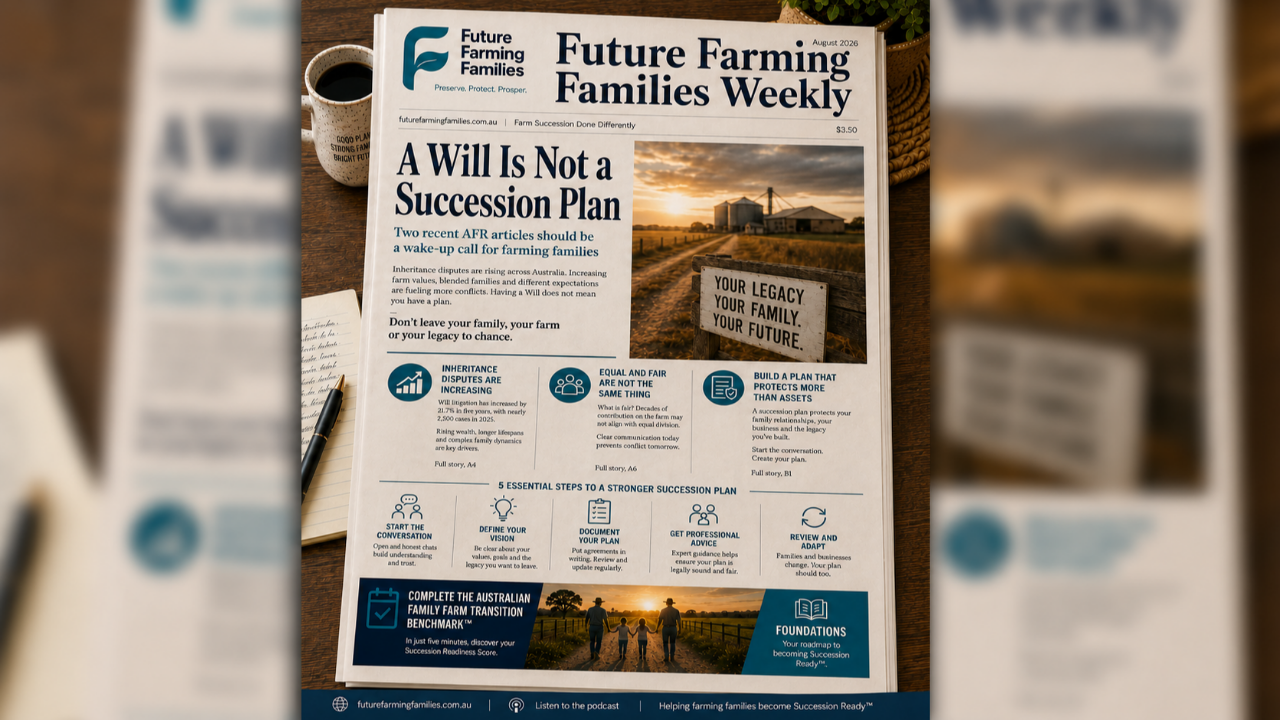
Two recent AFR articles should be a wake-up call for farming families
Over the past month, two articles have appeared in the Australian Financial Review that I think every farming family should pay attention to. And they are very concerning.
The first, published in July, carried the headline “The fight for the family farm is now splitting heirs.” Then, just over a month later, came another: “Failure of the Will Triggers Inheritance War.”
Individually, both articles are concerning. Put them together and I think there is a very clear warning for farming families.
The risks surrounding farm succession planning, estate planning and the transfer of family wealth are increasing and farming families are sitting right in the middle of it.
This isn't about trying to frighten people or suggesting that every family is destined to end up fighting over the farm. It's about recognising what is happening around us, understanding why these disputes occur and taking action while we still have the opportunity to control the controllable.
Because there is an important lesson in these stories that every farming family needs to understand:
Having a Will does not mean you have a succession plan.
Inheritance disputes are increasing
The most recent Australian Financial Review article reported a significant increase in wills and estates litigation across Australia. Across the Supreme Courts of New South Wales, Queensland, Victoria and Western Australia, attacks on the technical validity of wills increased from 650 five years ago to 998 last year. An increase of 53.4 per cent.
When contested probate and family provision claims are combined, the AFR reported that will litigation increased from 2,030 cases five years ago to 2,471 last year. An increase of 21.7 per cent.
Those numbers should get our attention, but I think the reasons behind them are even more important. The AFR points to increasing property values, greater amounts of wealth being transferred between generations, longer lifespans and questions around mental capacity, increasingly complex and blended families, different expectations among beneficiaries and existing family tensions.
When you think about those factors, it isn't difficult to see why the risks are increasing. Families are living longer, family structures can be more complicated and the amount of wealth sitting inside many estates has grown enormously. When expectations don't match what ultimately happens, the financial and emotional stakes can be very high.
For farming families, those issues can be magnified considerably.
Why family farm succession can be different
Only a month before the latest article, the AFR looked specifically at inheritance disputes involving farming families. Its headline — “The fight for the family farm is now splitting heirs” — captured the issue pretty well.
The article examined how increasing farm values are changing the dynamics of succession and inheritance, particularly when different family members have different expectations about who should ultimately receive the farm.
For many Australian farming families, what was once a relatively modest farming business has become an enterprise controlling millions and sometimes tens of millions of dollars of land and other assets. That wealth has often accumulated gradually over several generations, which means families don't necessarily think of themselves as controlling an estate of that magnitude.
The farm is simply the farm.
But a family farm isn't simply an investment portfolio waiting to be divided. It can be a business, a workplace, a home, a retirement plan, a source of income, a family legacy and the future livelihood of the next generation, all at the same time.
That is what makes family farm succession planning fundamentally different from simply dividing a pool of financial assets.
And it raises one of the most difficult questions in succession planning.
Equal and fair are not necessarily the same thing
What is fair?
Imagine one child has remained on the farm for 25 or 30 years. They may have worked long hours, accepted lower wages, helped expand the business, taken responsibility during difficult years and structured their entire working life around the farming enterprise. Perhaps Mum and Dad have repeatedly told them:
“One day, this will all be yours.”
Meanwhile, another child has left the farm, pursued a career elsewhere and built their own life. They may still have a strong emotional connection to the farm and reasonably believe that Mum and Dad always intended to treat all of their children equally.
Then Mum and Dad die.
One child believes decades of contribution and family promises mean they should receive the farm. Another believes their parents' assets should be divided equally.
Who is right?
That question becomes considerably harder when a farm that may once have been worth $2 million is now worth $10 million, $20 million or considerably more. The July AFR article highlights how increases in rural property values can substantially increase the financial stakes when family members have different expectations about an inheritance.
This is why the distinction between equal and fair matters so much in farm succession planning. Equal may be easy to calculate, but it doesn't necessarily recognise decades of contribution, sacrifice, risk or involvement in building the farming business. On the other hand, a farming child's expectation that they will receive the farm doesn't automatically mean their siblings have no legitimate expectations either.
There may not be one simple answer.
But there is one thing we can say with some confidence:
Leaving everyone to work it out after Mum and Dad have gone is probably one of the worst ways to resolve it.
A real family farm. A real dispute. A devastating outcome.
The July AFR article provides a sobering example of what can happen when these issues remain unresolved.
It tells the story of a Western Australian farming family involving a 447-hectare property south of Perth. After his father's death, the son moved onto the farm and worked to restore it. He later claimed his mother had told him he would eventually inherit the property, although the alleged promise had never been documented. His sister believed their parents' assets should be divided equally.
After their mother died, the disagreement ended up in the Western Australian Supreme Court. Following seven years of legal wrangling, the son's claim was dismissed, the farm was ordered to be sold and he was ordered to contribute $760,000 towards his sister's legal costs, in addition to bearing his own legal costs.
Think about that outcome for a moment.
A farming property that represented decades of family history and wealth became the subject of years of litigation. Enormous amounts of money were spent arguing about what Mum intended. Family relationships were damaged. Ultimately, the farm itself was ordered to be sold.
I suspect very few farming parents would look at that outcome and describe it as the legacy they wanted to leave their children.
But was the Will really the problem?
This is where I think we need to look a little deeper.
When we hear about an inheritance dispute, it's easy to describe it as a problem with someone's Will. But in many cases, the Will may simply be the point at which years — sometimes decades — of unresolved issues finally become visible.
The Will didn't necessarily create the problem. It revealed it.
The real problem may have started 20 or 30 years earlier. A promise was made but never documented. A son or daughter assumed they would eventually inherit the farm. Another child assumed Mum and Dad would divide everything equally. Mum and Dad may not even have agreed between themselves about what should happen. Nobody clearly defined what “fair” meant, and nobody wanted to start a difficult family conversation.
Meanwhile, the farming child continued working in the business. The off-farm children continued building their lives elsewhere. Farm values continued increasing. Mum and Dad got older. Everyone assumed there would be plenty of time to deal with succession later.
Then somebody dies.
Suddenly, the opportunity for that person to explain what they intended has disappeared. Assumptions can become accusations, expectations can become entitlements, old family tensions can reappear and disagreements that might once have been resolved around the kitchen table can end up being argued through lawyers.
That is why good farm succession planning needs to happen before estate administration begins, not after.
A Will is not a farm succession plan
This is one of the most important distinctions farming families need to understand.
Having a Will does not mean you have a succession plan.
A good Will is extremely important, and good estate planning is an essential part of farm succession planning. Tax planning, asset protection, ownership structures, powers of attorney and appropriate legal documentation all matter.
But they are pieces of a much bigger succession puzzle.
A Will primarily deals with what happens to particular assets following death. Farm succession planning asks a much broader set of questions.
Who will own or control the farming assets? Who will operate the farming business? How will Mum and Dad fund their retirement? What happens to existing debt? How should farming and non-farming children be treated? How are previous contributions recognised? What does fair actually mean for this particular family? What happens if somebody divorces, becomes incapacitated or dies unexpectedly? And how do we ensure the farming enterprise remains financially viable after the transition?
There is also another question that is sometimes overlooked:
Does everybody understand the plan?
You can have technically excellent legal documents, carefully considered tax structures and a beautifully drafted Will, but if the family doesn't understand what is intended and why, there may still be considerable succession risk.
If the first time your children discover your succession intentions is when your Will is read, there is a very real possibility that the succession conversation happened too late.
Silence isn't a farm succession strategy
One of the strongest observations in the July AFR article was remarkably simple:
“Silence isn't a viable strategy.”
I couldn't agree more.
In farming families, silence can sometimes feel like the easier option. Nobody wants to upset Dad. Nobody wants Mum worrying. The farming child doesn't want to appear entitled. The off-farm children don't want to look greedy. Parents don't want to feel as though they are choosing between their children.
So everyone avoids the conversation, and for a while that can feel like keeping the peace.
The problem is that avoiding conflict today can simply transfer a much bigger conflict to the next generation.
“We'll work it out.” “The kids know what we want.” “The Will will sort it out.” “We'll deal with it after another good year.” “It'll be right.”
We've all heard variations of those comments. But silence isn't a succession strategy.
And hope isn't a succession plan. The best estate dispute is the one your family never has
The objective of good succession planning shouldn't be to create documents that help your family win a future legal argument.
The objective should be to reduce the likelihood of that argument ever occurring.
That means having difficult conversations while the people who built the business are still here to participate in them. It means testing assumptions, documenting important agreements (such as the Family Farm Succession Deed), explaining decisions and considering the expectations of both farming and non-farming family members. It means combining good family communication with good commercial, taxation, legal and estate planning.
It also means recognising that fair does not automatically mean equal. But if the outcome isn't going to be equal, there needs to be careful consideration of why, how the farming business will remain viable and how those decisions are communicated and documented.
No farm succession plan can guarantee that a family will never disagree. But good planning can remove uncertainty, expose different expectations early and give the family an opportunity to work through those issues while everyone still has a voice.
The best estate dispute is the one your family never has.
Preserve. Protect. Prosper.
This is exactly what the 3Ps Philosophy — Preserve, Protect, Prosper — is about.
We want to Preserve the family, its relationships, its history and the farming legacy previous generations worked so hard to create. We want to Protect the family, the assets and the farming enterprise from unnecessary disputes, legal costs, tax consequences and unintended outcomes. And we want the family and farming business to Prosper, with a structure that allows the next generation to continue building upon what has already been created.
Farm succession isn't simply about transferring assets from one generation to another.
It's about transferring a viable farming business and a family legacy without unnecessarily damaging either in the process.
The recent AFR articles should therefore concern farming families. Not because every family is destined for a dispute, but because they demonstrate what can happen when significant wealth, family relationships, expectations and inadequate planning collide.
And as farm values increase, the financial consequences of getting succession wrong can increase with them.
Don't know where to start with farm succession planning?
This is where many farming families become stuck.
They know succession needs to be addressed. They know Mum and Dad aren't getting any younger. They know the farm has become increasingly valuable. They may even know there are different expectations within the family.
But they don't know where to start.
And when you consider everything involved, that's understandable. There is family, land, business structures, tax, estate planning, retirement, debt, farming children, non-farming children, fairness and legacy. Trying to solve everything at once can feel overwhelming, so farm succession planning gets put off for another harvest, another year and sometimes another five or ten years.
But here's the important point.
You don't need to solve everything today. You just need to establish where you are today.
That's why we've created the Australian Family Farm Transition Benchmark™.
It takes around five minutes and provides your family with a Succession Readiness Score — a starting point for understanding what's working, where the gaps may be and what conversations need to happen next.
You don't need to know all the answers before you start.
You just need to take the first step.
Don't know where to start? Start here.
Complete the Australian Family Farm Transition Benchmark™ and discover your Succession Readiness Score.
Become Succession Ready™.