FFF Insight 22 - Why Take the Risk? Can We Really Trust Politicians?
Oct 19, 2026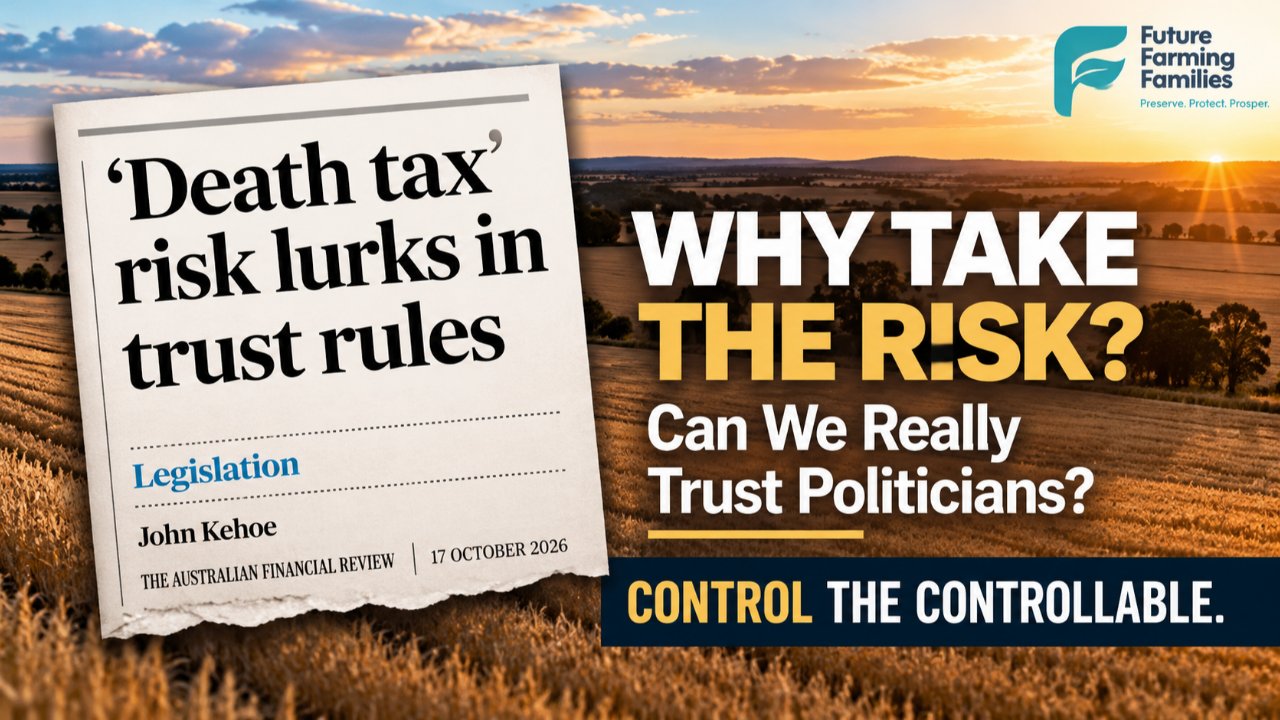
Control the Controllable.
The Australian Financial Review on Saturday, 17 October 2026, carried a headline that should get the attention of every family business:
"'Death tax' risk lurks in trust rules."
The article raises serious concerns about the Federal Government's proposed 30% minimum tax on discretionary trusts, scheduled to commence on 1 July 2028.
Despite assurances that genuine testamentary trusts would be exempt, legal and taxation experts are now warning that the proposed legislation may affect existing wills, particularly where testamentary trusts include companies or other trusts as potential beneficiaries.
Some experts are also raising concerns about the potential taxation consequences of transferring assets through estates.
The legislation was introduced into Parliament on 14 October 2026 and remains subject to parliamentary consideration. The final rules may change.
Importantly, this does not mean that every inheritance or transfer of farmland through an estate will automatically attract a 30% tax. The proposed measure is primarily a minimum tax on certain trust income, and qualifying exemptions remain important.
Nevertheless, the latest developments raise a much bigger question.
Why would farming families leave the future transfer of their assets to an uncertain taxation environment when opportunities may exist to implement their succession now?
Can We Really Trust Politicians?
This isn't about supporting one political party over another.
It's about recognising that governments change, taxation policies change and promises made today don't necessarily determine the legislation we'll be dealing with tomorrow.
We've seen plenty of examples over the years.
Remember Paul Keating's famous "L-A-W law" income tax cuts back in 1993? Those promised tax cuts were subsequently abandoned.
Then there was John Howard and the distinction between "core" and "non-core" promises. A reminder that political commitments don't always translate into government action.
And more recently, Prime Minister Anthony Albanese ruled out changes to negative gearing and Capital Gains Tax concessions before the election.
Yet in the May 2026 Federal Budget, the Government announced significant changes to both. When questioned about the reversal, the Prime Minister acknowledged:
"We've changed our position."
Regardless of whether you agree with these decisions, the lesson for farming families is clear.
Political promises are not guarantees and taxation rules that exist today may not be the rules that apply tomorrow.
Once Tax Changes Become Law, Will They Ever Be Reversed?
There's another important consideration. Once taxation changes are legislated and begin generating revenue, they can be difficult for future governments to reverse.
Opposition parties may strongly criticise new taxes or promise to repeal them. But when they eventually form government, the financial reality can be quite different.
Repealing an established tax measure means giving up revenue that may already be funding government expenditure. That's not to say tax changes are never reversed. They are.
Once the rules change, we may be living with those consequences for many years, regardless of which political party is in government.
We're seeing further concerns about the proposed 30% minimum tax on discretionary trusts and the treatment of testamentary trusts.
The Government has indicated that genuine testamentary trusts will be exempt and legitimate farming assets will be exempt. But legal and taxation experts are questioning whether the proposed legislation delivers that outcome in all circumstances.
The final rules may change before commencement.
For farming families with $20 million or more in net assets, this uncertainty matters.
After decades of building family wealth, why leave the future transfer of those assets dependent on political promises and taxation rules that may change?
Control the Controllable.
This is something we regularly discuss. There are plenty of things in business and life that we simply cannot control.
We cannot entirely control commodity prices or interest rates, we cannot control seasonal conditions or what governments might do with taxation legislation.
But we can control how we prepare and respond.
And when it comes to farm succession, there may be significant opportunities available today.
- Preserve — Understand the Taxation Opportunities
Many farming families currently have access to valuable taxation concessions that may allow farmland and business assets to be transferred or restructured with substantially reduced taxation consequences.
These may include:
- Small Business Capital Gains Tax Concessions, including the 15-year exemption, retirement exemption and active asset reduction.
- Small Business Restructure Rollover provisions, where the relevant requirements are satisfied.
- State-based stamp duty exemptions, including qualifying family farm transfers.
- Other applicable CGT rollovers and estate planning concessions.
These provisions can potentially preserve hundreds of thousands, and in some circumstances millions, of dollars in family wealth.
However, the availability of these concessions depends on ownership structures, asset values, business operations and eligibility requirements.
The opportunity is to compare the alternatives while the family still has choices.
- Protect — Don't Leave Everything to the Will
A will is an essential estate planning document.
But a will is not a succession plan.
A will generally determines what happens to assets after someone dies.
It doesn't necessarily resolve who should manage the farming business, how ownership and control will transition, how non-farming children will be treated or how the parents' financial security will be protected.
As the latest proposed taxation changes demonstrate, relying on testamentary arrangements may introduce additional uncertainty.
For many families, a better approach may be to establish appropriate ownership structures and succession agreements while the parents are alive.
This can provide greater clarity over control, asset protection, financial arrangements and the future ownership of the farming business. In one word – certainty.
It also gives the family an opportunity to address potential disagreements before they become disputes – expensive from a legal perspective and destructive to family relationships.
- Prosper — Give All Generations Certainty
One of the most common situations we encounter involves the next generation having worked in the farming business for 10, 15 or even 20 years.
They are managing the operation, making significant business decisions and often carrying substantial responsibility.
But they still don't know when, or even if, ownership and control will transfer.
That uncertainty can affect investment decisions, borrowing arrangements, business growth and family relationships.
A properly implemented succession plan can give the next generation the confidence to move forward.
And just as importantly, it can give the parents confidence that their financial security, retirement plans and family objectives have been properly addressed.
Why Wait Until Someone Dies?
Consider a farming family with $20 million in net assets, including farmland, machinery and other business assets.
The parents are approaching retirement. The next generation has been involved in the farming business for 15 years and is ready to take over.
After decades of hard work, the family has built substantial wealth. But much of that wealth remains tied up in assets owned by the parents or held in structures that may no longer be appropriate for the next generation.
With $20 million in net family wealth at stake, why would you leave the succession to chance?
The family has two broad options.
Option 1 — Leave the assets to transfer through the estate.
The parents retain ownership/control and rely on their wills to determine what happens when they die.
Depending on the circumstances, the family may then need to deal with estate administration, ownership and control issues, potential disputes and whatever taxation rules apply at that time.
Option 2 — Investigate completing the succession now.
The family reviews the current ownership structures, taxation concessions, retirement funding requirements and succession objectives.
Where appropriate, assets and control are transferred to the next generation under a carefully structured arrangement (Family Farm Succession Deed).
The parents' financial security is protected, the next generation gains certainty and the family has the opportunity to implement the succession together.
But surely the sensible approach is to investigate both options now, rather than simply assume that leaving everything to the will is the best solution?
What Should Farming Families Be Doing Now?
With significant taxation changes proposed over the next two years, we believe farming families should be reviewing their arrangements sooner rather than later.
That review should consider:
- Ownership structures: Who currently owns the farmland, business assets and investments, and are those structures appropriate for the next generation?
- Taxation opportunities: What CGT concessions, rollovers and stamp duty exemptions are currently available, and how might proposed reforms affect them?
- Parents' financial security: What assets, income and capital do the parents need to fund the rest of their lives?
- Succession arrangements: Is the next generation ready to assume genuine ownership, management and control?
- Wills and testamentary trusts: Do existing estate planning arrangements remain appropriate in light of the proposed reforms?
The objective isn't to rush into transferring assets simply because taxation legislation may change.
It is to understand the opportunities, quantify the financial consequences and make informed decisions while there is still time to act.
Our Message — Why Take the Risk?
We cannot control what the Federal Government will do next.
We cannot guarantee which taxation concessions will remain available in five or ten years, and we certainly cannot guarantee that the rules applying when someone dies will be the same as those applying today.
But we can control how we prepare.
We can review ownership structures.
We can understand the concessions currently available.
We can develop a succession plan that protects the parents and gives the next generation certainty.
And where the family is ready and the financial, taxation and legal outcomes support it, we can implement that plan during the parents' lifetime.
The greatest risk may not be what the government changes. It may be what your family fails to do before those changes take effect.
Why take the risk?
Control the Controllable - A will is not a succession plan.
How Succession Ready™ Is Your Family?
At Future Farming Families, we're helping farming families understand their options, identify potential risks and take practical steps towards becoming Succession Ready™.
Our Australian Family Farm Transition Benchmark is designed to help families assess their Succession Readiness and identify areas that may require attention.
It's a starting point for understanding where your family stands and what needs to happen next. It takes around 5 minutes to complete and you will obtain your Succession Readiness Score. Click on the link and complete the Australian Family Farm Transition Benchmark today.
Future Farming Families — Family-led. Adviser-supported.
Important information: This Insight provides general information, not individual taxation or legal advice. It discusses proposed legislation and concerns reported in the Australian Financial Review on 17 October 2026. The final legislation, commencement provisions and exemptions may change. Professional advice should be obtained before implementing any asset transfer or restructuring.