FFF Insight 23 - Choose Your Own Adventure
Oct 26, 2026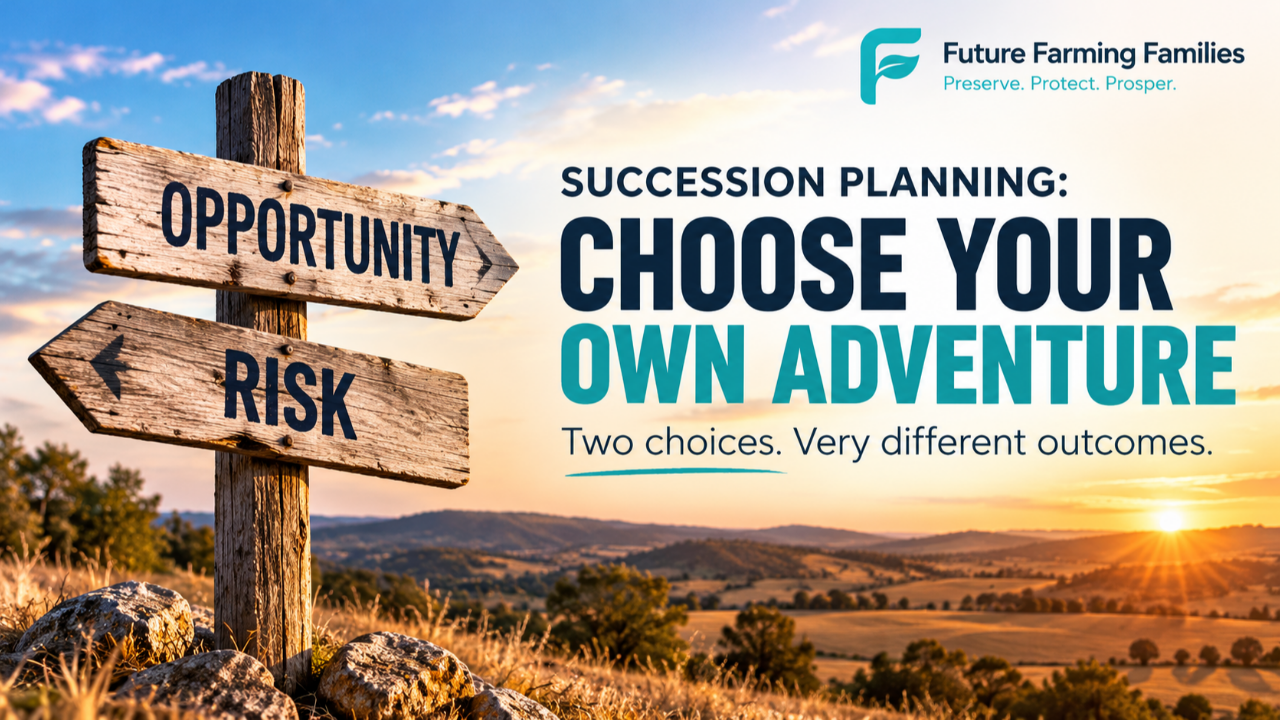
Succession Planning: Choose Your Own Adventure
Future Farming Families | Future Insight
Let Me Give You Two Scenarios
Scenario 1 — The Opportunity
What if I told you that investing $10,000, $20,000 or even $30,000 in succession planning could potentially preserve or protect $1 million and more than likely several million dollars of your family's wealth?
Would you make that investment?
Scenario 2 — The Risk
Now, what if I told you that NOT investing that same $10,000, $20,000 or $30,000 could end up costing your family $1 million and potentially several million dollars?
Would that change your thinking?
Same investment. Same family. Same potential financial outcome. But two very different ways of looking at the decision.
Welcome to this week's Future Insight - Choose Your Own Adventure.
Of course, these are illustrative scenarios rather than guaranteed outcomes. Every family's circumstances are different, but they raise an interesting question. Why do we sometimes need to be frightened of losing something before we're motivated to protect it?
Pain, Pleasure and Human Nature
Human behaviour is fascinating. Much of what motivates us comes down to two things -avoiding pain and seeking pleasure. Research into behavioural economics suggests that, generally speaking, the pain of losing something can be more powerful than the pleasure of gaining something of equivalent value. It's known as loss aversion.
Think about our two scenarios. In the first, we're talking about an opportunity to preserve or protect wealth. In the second, we're talking about potentially losing that same wealth. The financial implications might be similar, but emotionally they can feel very different.
Now let's apply that thinking to farm succession planning. Most farming families understand that succession planning is important. They know that at some point decisions will need to be made about ownership, management, retirement, the next generation and the future of the family farm. Yet many continue to put it off.
Why?
The Pain of Starting
I suspect one of the biggest obstacles to succession planning isn't the financial investment. It's the emotional investment.
Starting succession planning can mean having conversations that families would rather avoid. Who will take over the farm? What happens to the children who aren't farming? How will Mum and Dad fund their retirement? When will the next generation have control and perhaps the most uncomfortable question of all is what happens if everyone doesn't agree?
These aren't necessarily easy conversations, and when we're faced with something uncomfortable, human nature often encourages us to avoid it. The immediate discomfort of starting can feel greater than the potential consequences of doing nothing, particularly when those consequences might still be years away.
So we convince ourselves there's no urgency. We'll deal with it after harvest, when the kids are older, when the debt is lower, when Mum and Dad are ready, or perhaps next year. There always seems to be a good reason to put it off, and before we know it, another five years have passed.
The problem is that time doesn't necessarily make succession planning easier. In many circumstances, it can make it considerably more difficult.
When Pain Becomes the Motivator
Over my years working with farming families, I've seen circumstances change very quickly. A serious illness, an unexpected death, a marriage breakdown, financial difficulties or a disagreement between family members can suddenly turn succession planning from something that should be considered into something that must be addressed immediately.
Conversations that could have taken place over several years now need to happen in weeks or months. Decisions that could have been made calmly and collaboratively are being made under enormous emotional and financial pressure. And sometimes, valuable opportunities have already disappeared.
Taxation concessions may no longer be available, ownership structures may be difficult to change, retirement options may be limited and family relationships may already be strained. What could have been a carefully considered transition becomes an exercise in managing a crisis, often with fewer options and considerably greater professional expenses.
The irony is that families who wanted to avoid the discomfort of succession planning can find themselves dealing with something considerably more painful.
And that's the danger of waiting until circumstances force us to act.
Doing Nothing Is Still a Decision
Here's something I think we need to recognise. Not making a decision is, in itself, making a decision.
When a family chooses to delay succession planning, they're effectively choosing to continue with their existing arrangements. That might be perfectly appropriate for a period of time, particularly where the family has considered its circumstances and made an informed decision. But it shouldn't happen simply because nobody wants to start the conversation.
There is an important difference between making an informed decision to wait and avoiding a decision altogether. One is deliberate, while the other is procrastination. And procrastination can be expensive, not just financially, but in terms of missed opportunities, uncertainty, business performance and family relationships.
Every year that passes is another year in which the next generation may be reluctant to invest because they don't know what their future looks like. It's another year in which parents may be postponing retirement because they haven't worked out how to fund it. And it's another year in which the family may be missing opportunities to improve its ownership structures, protect assets or take advantage of available taxation concessions.
Doing nothing might feel like the safest and easiest option today, but that doesn't mean it's without consequences.
What If We Focused on the Pleasure Instead?
Let's return to our first scenario. What if we stopped thinking about succession planning as something difficult that we have to do, and instead started thinking about what it could make possible?
Imagine parents having confidence that they can retire comfortably, knowing the farm and their family are in good hands. Imagine the next generation having the certainty to invest, expand and build their own future. Imagine family members understanding what the future looks like, even if they aren't actively involved in farming, and the peace of mind that comes from knowing the family has worked through the difficult questions together.
These are the real opportunities that succession planning can create. Yes, there can be substantial financial benefits through taxation planning, asset protection, better business structures and improved financial management. But some of the greatest benefits aren't financial at all.
I've often said that one of the best measures of a successful farm succession plan is whether the whole family can still sit around the Christmas table together. We can calculate taxation liabilities, asset values, debt levels and retirement funding requirements, but how do we calculate the value of maintaining strong family relationships?
How do you put a dollar value on that?
For many families, preserving those relationships is worth more than any financial benefit succession planning might deliver.
Succession Planning Is a Journey, Not an Event
One of the biggest misconceptions about succession planning is that families need to have all the answers before they begin. They don't. In fact, trying to solve everything at once can be one of the reasons families never get started.
At Future Farming Families, we often talk about what we call Succession Canyon™ - the gap between where a farming family is today and where they want to be in the future. On one side of the canyon is the current situation, with existing ownership structures, financial arrangements, family expectations and sometimes considerable uncertainty. On the other side is the future the family hopes to achieve - financial security for the retiring generation, opportunities for the next generation and, importantly, strong family relationships.
The challenge is working out how to get from one side to the other. And that's where succession planning comes in.
You don't cross the Succession Canyon in one giant leap. You build a bridge, one decision at a time.
Successful succession planning is often a journey over five, ten or even fifteen years. It's about understanding where the family is today, agreeing on where everyone wants to be, identifying the obstacles standing in the way and progressively making the decisions needed to bridge that gap.
Some of those decisions may involve changes to business management, while others may relate to retirement funding, ownership structures, taxation planning or the eventual transfer of assets. They don't all need to be made tomorrow. The important thing is that the family has a direction and understands the pathway forward.
That journey can begin with something as simple as having the first conversation. Understanding the family's goals, identifying the opportunities and risks, and agreeing on what needs to happen next are all important steps towards becoming succession ready.
The earlier you start building the bridge, the more options you have. Leave it too long, and circumstances may determine how or even whether you get across.
So, Which Adventure Will You Choose?
Let's revisit those two scenarios.
Would you invest $10,000, $20,000 or $30,000 if it meant potentially preserving or protecting $1 million or more of your family's wealth? Or would you make that investment if you knew that failing to act could potentially cost your family $1 million or more?
The reality is that both scenarios are possible, depending on a family's circumstances. And the difference between them can come down to when a family decides to act.
But perhaps there's an even more important question.
What could getting started today mean for your family's future - financially and personally?
At Future Farming Families, we believe succession planning should be about much more than transferring assets from one generation to the next. It's about preserving what generations have worked hard to build, protecting family relationships and creating opportunities for future generations to prosper.
This all starts with a decision.
Because doing nothing is also a choice and sometimes it can be the most expensive one.
Control the controllable. You don't need to have all the answers. You just need to get started.
Where Do You Start?
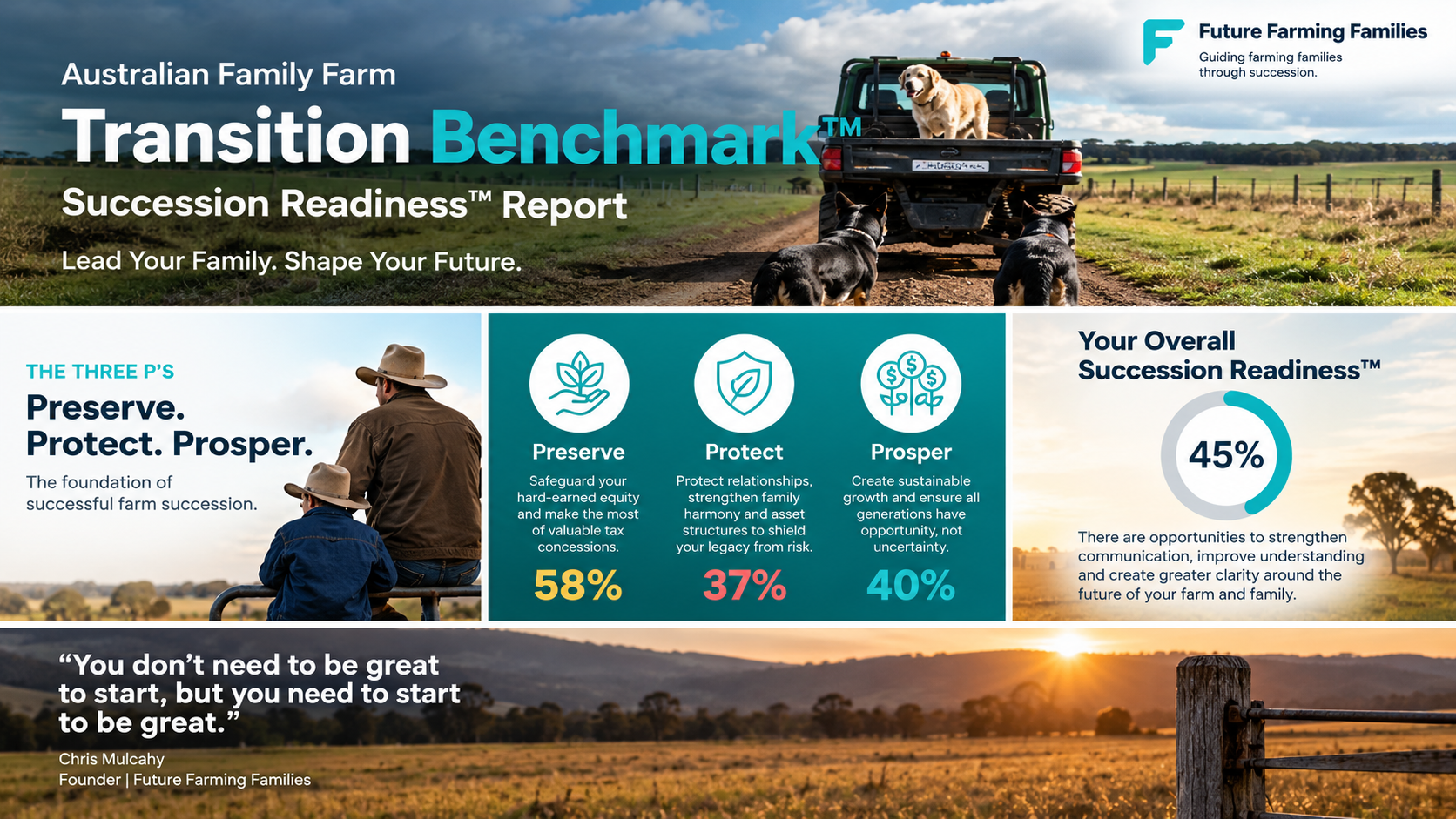
If you're unsure where your family stands, a good first step is to complete the Australian Family Farm Transition Benchmark. It has been developed to help farming families understand their current level of succession readiness and identify areas that may need attention.
Take the Australian Family Farm Transition Benchmark
Next week, we'll explore what succession planning could actually be worth to your family — including the financial consequences of doing nothing and the opportunities that proactive planning can create.