FFF Insight 20 - What do we do?
Oct 06, 2026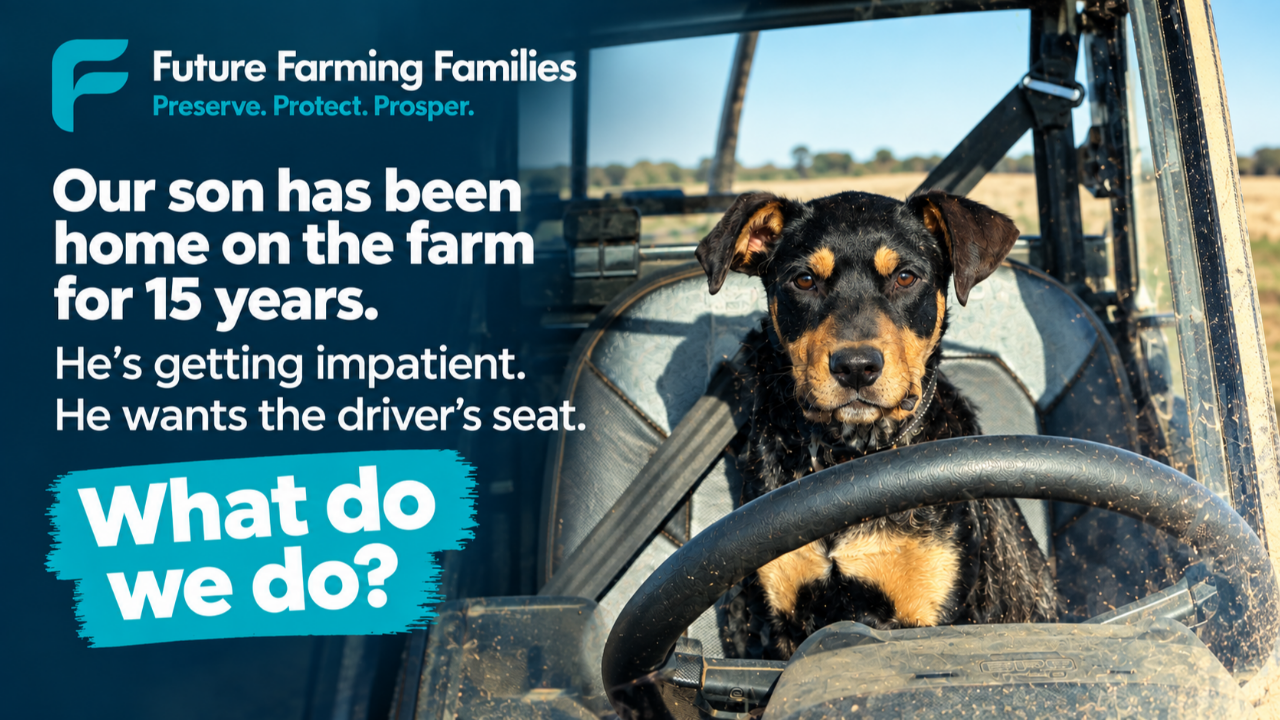
Our Son Has Been Home on the Farm for 15 Years. He’s Starting to Get Impatient. What Do We Do?
Before we start, this could just as easily be a daughter. Every farming family is different. But in this situation it is the son who came home to the family farm around 15 years ago.
He came home in his early twenties. He’s now heading toward 40, has a partner and 2 children of their own. He has spent most of his working life on the family farm and, after 15 years, he’s starting to ask a pretty reasonable question:
“What’s actually happening here?”
That doesn’t necessarily mean he wants Mum and Dad gone. It doesn’t mean he thinks he’s entitled to the farm and it doesn’t necessarily mean he’s being unreasonable or impatient.
He and his partner simply want to know what their future looks like.
The interesting thing is that those 15 years can look very different depending on which side of the kitchen table you’re sitting on.
From Mum and Dad’s perspective, they might be wondering what all the urgency is about. They may only be in their mid 60s, still enjoy farming and have no intention of retiring anytime soon. They’ve spent their whole lives building the farm, they still have plenty to contribute, and they may not even know exactly what they want the next 10 or 20 years of their own lives to look like. They have 3 other children who grew up on the farm and are now working elsewhere.
They might also genuinely believe they have already dealt with succession.
“It’s all sorted out in our Wills.”
Perhaps their Wills leave the farm, or a substantial part of it, to their farming son, off farm assets to the other children. From Mum and Dad’s perspective, that might seem fair. They know what they intend to happen eventually, so they assume their son knows too.
But a Will is not a succession plan.
A Will might determine what happens to certain assets when Mum or Dad dies. It doesn’t necessarily tell their son what happens next year, in five years or in ten years. It doesn’t tell him when he will take over management, when he will have greater decision-making authority, whether he will eventually have control of the farming business, or what happens if Mum and Dad are still happily farming in another 20 years.
There may be another part of the story that Mum and Dad see very differently.
Their son has always received a wage from the farm. Mum and Dad might say, “We’ve always paid him. He’s never worked here for nothing.”
That may be absolutely true. But what if, over those 15 years, his wage has averaged only around 50% of what he might reasonably have earned elsewhere for a comparable role?
Perhaps everyone accepted that arrangement in the early years because there was an expectation that he was building towards something. Nobody necessarily documented what that “something” was. There may simply have been an understanding that one day he would have a greater role in the farm.
Fifteen years later, that can become a very different conversation.
This doesn’t automatically mean the farm owes him the difference. Nor does it mean he has earned an entitlement to a particular parcel of land. Every family and every situation is different. But it does mean his contribution needs to be recognised and discussed.
Because from his side of the kitchen table, he may be thinking: I’ve given 15 of my best working years to this business. I’ve accepted a lower wage because I thought I was building towards something. I now have a partner and children of my own. I just need to know where this is heading.
From Mum and Dad’s side, they probably have plenty of legitimate concerns as well. Is their son really ready? Can he manage the farm financially? Can he lead the business? What happens to the other children? How do Mum and Dad fund their retirement? Where will they live? What happens if their son’s relationship breaks down? And what if they hand over too much, too soon, and regret it?
These are all reasonable concerns and this is where family farm succession can become difficult, because both sides can be right.
Mum and Dad aren’t necessarily trying to hold their son back. Their son isn’t necessarily being impatient or entitled. They may simply be looking at the same 15 years through very different eyes.
Over time, uncertainty can become frustration. Frustration can become impatience and eventually, impatience can become resentment.
That’s when succession stops being purely a financial, tax or legal issue and starts becoming a family relationship issue.
It can be easy for Mum and Dad to say, “He’s getting impatient.”
But perhaps impatience isn’t really the problem.
Maybe the real problem is that nobody has defined the pathway forward.
And this is where farming families need to understand that there isn’t really just one succession plan. There are two succession paths, and while they are connected, they don’t necessarily have to happen at the same time.
The first is Management and Leadership Succession.
Who is going to lead the farming business into the future? Who makes the operational decisions? Who manages the team? Who deals with the bank, agronomist and other advisers? Who prepares the budgets? Who makes the major farming decisions? And ultimately, who takes responsibility for the performance of the business?
There is also an important structural question to consider: does the existing enterprise structure actually allow for the management and control of the operating business to progressively transition to the next generation?
For example, can the son or daughter progressively take greater responsibility for the operating entity without Mum and Dad having to immediately transfer ownership of the underlying farmland and other major assets?
This can be an important distinction.
Mum and Dad may want to retain control of the land for some time, whether for financial security, asset protection, tax and estate planning reasons, or simply because they aren’t ready to transfer it. But that doesn’t necessarily mean they need to retain the day-to-day management and control of the farming operation as well.
The right enterprise structure can provide flexibility for the next generation to progressively take over the management, leadership and control of the operating business, while Mum and Dad continue to own the underlying farmland and other significant assets.
The second path is Ownership and Control Succession.
This looks further ahead at who ultimately owns and controls the family’s assets. Who owns the land? Who owns the other farming assets? Who controls the companies and trusts? When and how might ownership change? How will Mum and Dad remain financially secure? How will assets be protected and how will the interests of the non-farming children be considered?
These two paths are connected, but they don’t have to move at the same speed.
That is incredibly important. Mum and Dad might not be ready to transfer control of the farm. That doesn’t mean their son or daughter can’t start taking greater responsibility for leading it.
Management and leadership might begin transitioning today. Ownership of the land might transition in five or 10 years as part of the succession plan and Family Farm Succession Deed.
Perhaps, then, one of the most important questions isn’t:
“When are Mum and Dad going to hand over the farm?”
Perhaps the better question is:
“Is the next generation being given the opportunity to lead?”
Ownership can take time. There may be tax issues, retirement needs, estate planning considerations, debt, business structures, non-farming children and many other matters that need to be worked through before major assets change hands.
But leadership can start transitioning much earlier.
That might mean the farming son or daughter starts running the monthly farm meeting. They might become responsible for preparing and reporting against the annual budget. They might take the lead with the bank. They might manage employees. They might prepare the machinery replacement plan. They might have greater authority over cropping, livestock and other operational decisions. They might become director of the trustee company or trading company.
Mum and Dad are still there. They still control the farm. They still have an important role.
But gradually their role starts to change from making every decision to helping the next generation develop the capability, confidence and responsibility to make those decisions themselves.
That is succession too.
And perhaps this is where some farming families become stuck. They think succession begins when the land is transferred, or that because they’ve dealt with the farm in their Wills, succession has somehow been completed. It hasn’t.
A Will can be an incredibly important part of the family’s estate plan, but a Will is not a succession plan.
Succession starts much earlier, while Mum and Dad are still alive, healthy and involved in the business. It starts with developing the next generation’s capability, responsibility and leadership, while also working through the longer-term transition of ownership and control.
The danger is waiting until somebody finally reaches their tipping point and says:
“I’ve had enough.”
By then, the farming child may be angry. Their partner may be frustrated. Mum and Dad may feel pressured. The non-farming children may suddenly become concerned about what is happening.
Decisions that could have been worked through calmly over several years suddenly become urgent and succession is much harder when decisions are being made under pressure.
So, if your son or daughter has been home on the farm for 10 or 15 years and is starting to become impatient, don’t automatically assume they are asking you to hand over the farm tomorrow.
They might simply be asking:
“Where is this heading, and what is my role in it?”
Start working on the Management and Leadership Succession Plan.
At the same time, start developing the longer-term Ownership and Control Succession Plan.
The two paths can move at different speeds, but they should ultimately be heading in the same direction.
And perhaps there is one question worth asking your family this week.
If your son or daughter has been home on the farm for 10 or 15 years:
Are you still managing them as an employee, or are you developing them as the future leader of the family farming business?
Because becoming Succession Ready™ doesn’t start with handing over the farm.
And it doesn’t start with what’s written in your Will.
It starts with leadership.
How Succession Ready Is Your Family?
If some of this sounds familiar, a good place to start is the Australian Family Farm Transition Benchmark.
The Benchmark has been designed to help farming families step back and assess where they currently sit with succession - what they have already addressed, where the gaps might be, and what needs greater attention.
It looks across the key areas that contribute to becoming Succession Ready™ and gives you a clearer picture of where your family is today.
Take the Australian Family Farm Transition Benchmark and see how Succession Ready™ your family really is.