FFF Insight 24 - Parents It's Time to Step Up and Lead
Nov 02, 2026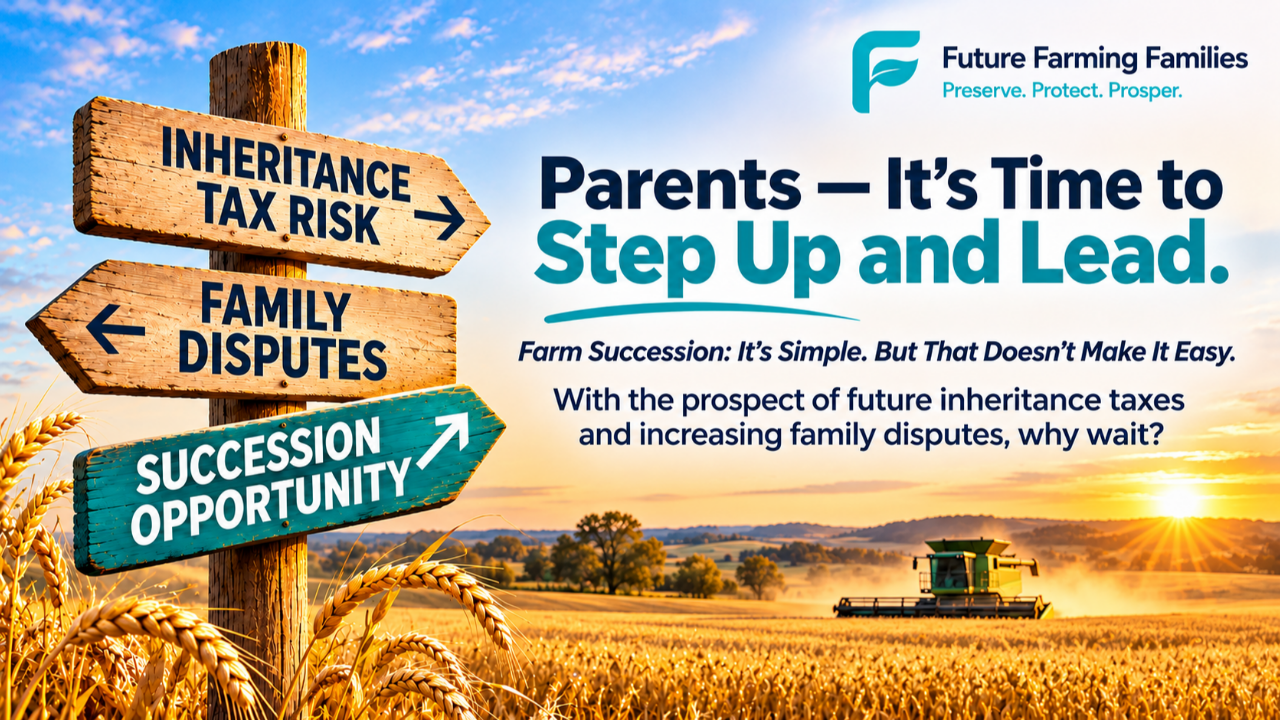
Farm Succession: It's Simple. But That Doesn't Make It Easy.
With the prospect of future inheritance taxes and increasing family disputes, why wait?
Farm succession is often simple to understand, difficult to discuss, and even harder to do. But doing nothing doesn't make it any easier.
For many farming families, the biggest challenges aren't necessarily taxation, legal structures or financial arrangements. They're people, relationships, expectations and emotions. Mum and Dad might be worried about losing control or their financial security, the farming children want certainty about their future, and the non-farming children want to know they'll be treated fairly.
Rather than having those difficult conversations, families often put succession off for another year, another harvest or another decade.
But while families are waiting, the world around them continues to change. Farmland values increase, family circumstances change, taxation legislation evolves and expectations become more entrenched. What might have been relatively straightforward to address five or ten years ago can become considerably more difficult.
Two developments should be getting the attention of Australian farming families right now: the possibility of future inheritance taxes and increasing disputes over family farms.
Is an Australian Inheritance Tax Only a Matter of Time?
This week, The Australian published an article with the headline, “Why a death tax is ‘inevitable’ as Boomers pass down trillions.”
Estate planning lawyer Morgan Solomon believes Australia will eventually introduce an inheritance tax as trillions of dollars in wealth pass between generations.
Whether he's right remains to be seen. Australia currently has no general inheritance tax, and the Federal Government has not announced plans to introduce one. But can anyone confidently say that will remain the position in five, ten or twenty years?
Consider an Australian farming family with $20 million in net assets. While that represents considerable wealth, much of it may be tied up in farmland, livestock, machinery and infrastructure, with relatively little cash available.
If a future government introduced a hypothetical inheritance tax of 20% on taxable estate values exceeding $10 million, that family could face a $2 million tax liability, assuming the entire $20 million formed part of the taxable estate.
Where would the money come from? Would the family need to borrow, sell farmland or dispose of other assets? And what would that financial pressure do to relationships between the farming and non-farming children?
The United Kingdom provides a timely reminder that taxation legislation can change. In April 2026, restrictions on agricultural inheritance tax relief commenced, potentially exposing higher-value farming assets to substantial inheritance tax liabilities. Despite considerable opposition and hopes that the changes might be reversed under new political leadership, the restrictions remain.
Importantly, the UK inheritance tax regime can also apply to assets held in trusts. Simply having farmland in a trust does not guarantee protection from future taxation changes.
We can't predict whether Australia will introduce an inheritance tax, but the UK experience demonstrates why we shouldn't assume today's taxation arrangements will remain unchanged forever.
Family Disputes — The Risk That's Already Here
While a future Australian inheritance tax remains uncertain, another significant risk is already affecting farming families: disputes over the family farm.
In July, The Australian Financial Review published an article titled “The fight for the family farm is now splitting heirs.” The article highlighted growing concerns among lawyers about succession disputes as farmland values increase and expectations between farming and non-farming children become more difficult to reconcile.
One example involved a Western Australian farming family whose inheritance dispute ended in the Supreme Court after years of litigation. The farm was ordered to be sold, and substantial legal costs followed. What the parents had intended to leave as a family legacy became the subject of a prolonged dispute.
The article also referred to research indicating that only 18% of respondents had held detailed discussions about estate planning.
That's concerning, particularly when we consider the value of assets involved in modern farming businesses.
Imagine a farming child who has worked on the family farm for 30 years, perhaps accepting lower wages or making personal sacrifices on the understanding that they would eventually take over. Meanwhile, their brother or sister may have pursued a career elsewhere and reasonably expect to receive a share of the family wealth.
Mum and Dad might believe everyone understands what will happen. But unless those expectations have been discussed and documented, there's a real possibility that family members have very different understandings of what has been promised.
And as farmland values increase, the financial consequences of those differences become much greater.
Fair doesn't necessarily mean equal, and equal doesn't necessarily mean fair.
There isn't always a simple answer to how family wealth should be divided, particularly when one or more children have contributed significantly to building and operating the farming business. But avoiding the discussion rarely makes the problem disappear.
A properly structured family trust can provide considerable flexibility, but even the best structure won't prevent a dispute if the family hasn't agreed on what it is trying to achieve.
Why Succession May Be Simpler to Implement Today
This brings me to what I believe is the most important point.
We have an opportunity to implement succession arrangements under today's known taxation legislation, rather than waiting to see what future governments might introduce.
Australia currently has established capital gains tax concessions, rollover, restructuring provisions and ownership structures that may assist farming families with transitioning their businesses and assets between generations. Those opportunities won't necessarily remain available in their current form forever.
For many farming families, a preferred structure can be a properly established discretionary family trust. Not simply because of the potential taxation benefits, but because of the flexibility it can provide when transitioning a farming enterprise over time.
Succession doesn't need to happen overnight. Mum and Dad can initially retain control while the next generation progressively assumes greater management responsibility. Over time, the trustee company and appointor arrangements can be transitioned, allowing the next generation to take control of the farming enterprise while the underlying farmland continues to be owned by the same trust.
That can be a significant advantage compared with personally owned farmland, where transferring ownership to the next generation may involve capital gains tax, stamp duty and other costs.
Of course, trusts aren't appropriate for every family, and transferring personally owned farmland into a trust can itself have significant taxation and duty consequences. Changes to trustee companies and control arrangements also need to be carefully considered.
But the broader principle remains: the right ownership structures can provide families with the flexibility to implement succession progressively over five, ten or fifteen years, rather than leaving everything until retirement or death.
And the earlier families begin considering their options, the more time they generally have to develop and implement arrangements that suit their circumstances.
If future governments introduce inheritance taxes, restrict existing capital gains tax concessions or change the taxation of trusts, some of the opportunities available today may become more expensive or difficult to access.
That doesn't mean families should rush into restructuring because of speculation about future legislation. It means they should understand their options and make informed decisions while they have the opportunity.
Parents — Succession Starts With You
In most farming families, the parents still control the farmland, the business structures and the major financial decisions. They are generally in the best position to get succession moving, yet they are often reluctant to start.
Sometimes that's because they're worried about losing control or financial security. Sometimes they don't know how to treat their children fairly. And sometimes it's simply easier to keep doing what they've always done rather than confront potentially difficult family conversations.
All of those concerns are understandable, but they aren't reasons to avoid succession indefinitely.
Mum and Dad, it's time to step up and lead.
That doesn't mean you need to transfer the farm tomorrow or make every decision on behalf of your children. It means taking responsibility for getting the process started, bringing the family together and being prepared to discuss what the future might look like.
What do you want retirement to look like? How much financial security do you need? Who wants to continue farming? What opportunities should the next generation have? How will the non-farming children be treated fairly, and how can the family preserve both its wealth and its relationships?
These discussions may be uncomfortable, and not everyone will necessarily agree. Some family relationships are genuinely difficult, and there may be circumstances where joint discussions aren't appropriate. But those challenges make a structured process even more important.
Don't leave your children to fight over decisions you could have helped them make together.
The objective isn't necessarily to reach agreement on everything immediately. It's to establish a direction, document the arrangements and begin implementing succession progressively.
That's why at Future Farming Families we believe succession should be Family-led. Adviser-supported.
The family needs to determine what it wants to achieve. Advisers can then help develop the taxation, legal, financial and ownership arrangements to make it happen.
Why Wait?
When we bring all of this together, the case for starting succession becomes compelling.
We have speculation about future inheritance taxes, with the UK providing a real example of how changes to agricultural taxation can affect farming families. We have existing taxation concessions and restructuring opportunities that may not remain unchanged forever. And we have increasing concerns about family disputes as farmland values rise and different expectations become harder to reconcile.
Then there are the circumstances nobody can predict: illness, incapacity, relationship breakdowns or the unexpected death of a family member.
Any one of these events can make succession more difficult. Combined, they can create significant financial and emotional consequences for a farming family.
Yet many families continue to wait, hoping that somehow the right time will eventually arrive.
Farm succession may be relatively straightforward to implement today. Why wait until changing legislation, increasing family disputes or unexpected circumstances make it considerably harder?
We often talk about the financial cost of failing to plan succession, but the potential damage to family relationships can be just as significant. Years of disagreements, substantial legal costs and the breakdown of relationships between parents, children, brothers and sisters can undermine everything the family has worked to build.
Succession planning won't guarantee that every family member will be happy or that disputes will never arise. But clear communication, appropriate structures, documented arrangements and a progressive transition plan can substantially improve the family's position.
And importantly, you don't need to have all the answers before you begin.
At Future Farming Families, that's exactly why we've developed our Foundations program. It provides a structured process and practical tools to help families understand their existing position, begin the conversations and develop a succession roadmap.
You don't need to change accountants, and you don't need to solve everything tomorrow. But you do need to start.
Farm succession is often simple to understand, difficult to discuss, and even harder to do. But doing nothing doesn't make it any easier.
We can't predict the future. But we can prepare for it.
Parents, step up and lead. Why wait? Control the Controllables.
PRESERVE. PROTECT. PROSPER.
Future Farming Families
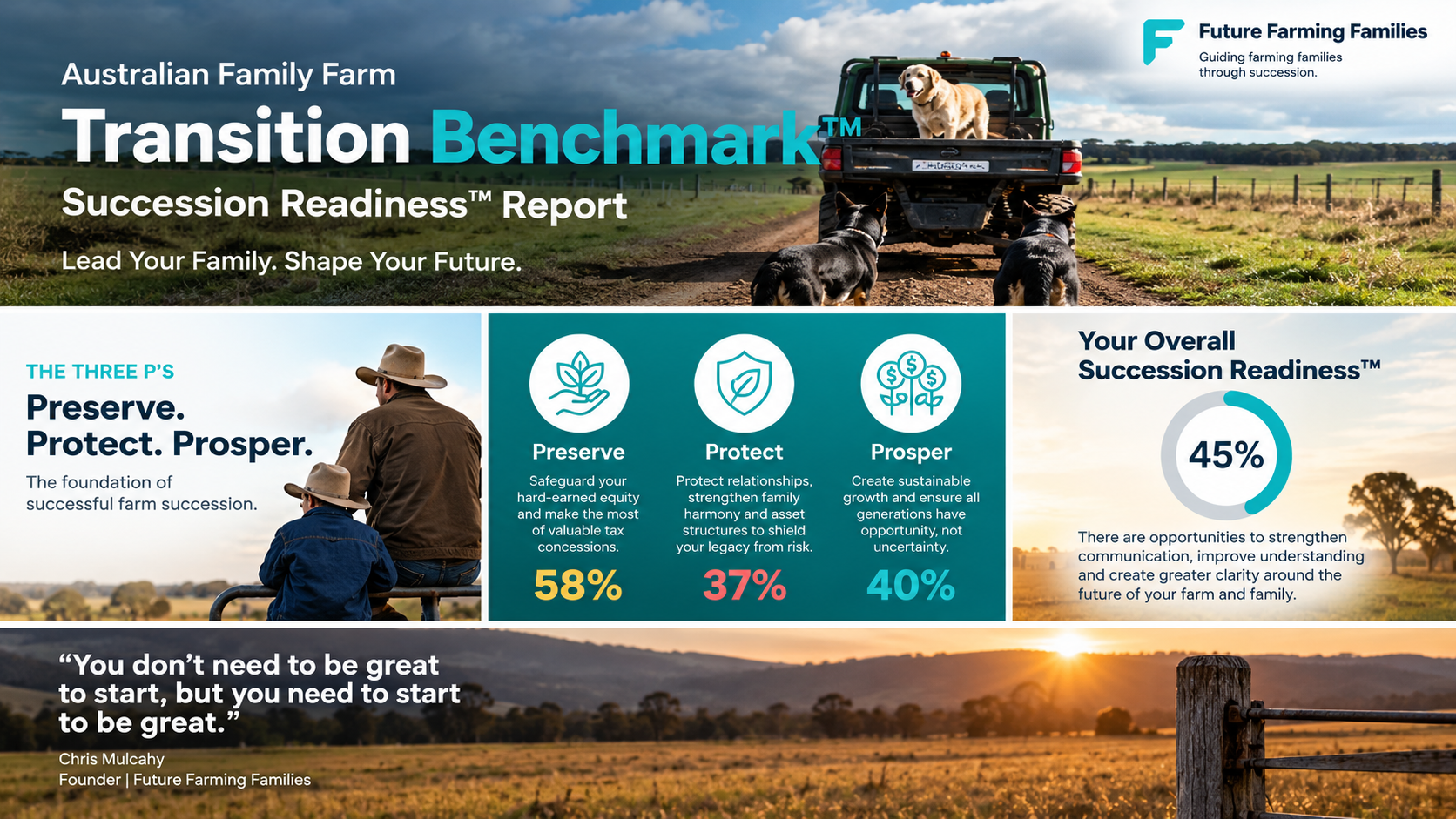
Check Your Family's Succession Readiness
Take the Australian Family Farm Transition Benchmark™ and discover how prepared your farming family is for the future.
www.futurefarmingfamilies.com.au